Can green cycling paths reduce commuter exposure to ultrafine particles?




“Can green cycling paths reduce commuter exposure to ultrafine particles?”. The short answer is yes.
The question
In cities, road traffic is the main source of ultrafine particles (UFP, particles smaller than 0.1 µm), that penetrate deep into the lungs and the circulatory system. Cycling is good for health and climate change, but it also increase our breathing rate right next to traffic emissions. Most cyclists underestimate how much pollution they breathe along the way.
So we asked a simple question: How much cycling on a the Nørrebro green cygling path, a path physically separated from traffic and running through green spaces, can actually lower UFP?
How we did it
Over six weeks in February and March 2024, we performed 40 cycling trips on a fixed 8.3 km route through central Copenhagen, during both rush hour (07:45) and non-rush hour (09:45). A portable DiSCmini measured particle number concentration (PNC) every second, paired with GPS, and we split the route into five segments by traffic volume and built environment: green path, low, moderate A, moderate B, and high traffic.
The statistics used generalized additive mixed models (negative binomial, random intercept per trip, AR(1) autocorrelation between consecutive disks, and cubic splines for meteorology).
What we found
−50%
Lower PNC on the green path versus high-traffic streets
−32%
Lower PNC on the green path versus moderate-traffic streets
5,849 pt/cm³
Mean PNC on the green path — the lowest of every segment
- After adjusting for confounders, cycling on the green path reduced UFP exposure by 32% to 50% compared with higher-traffic segments.
- Exposure was similar between rush and non-rush hours. The immediate built environment mattered more than the timing of the trip.
Where you ride matters more than when you ride.
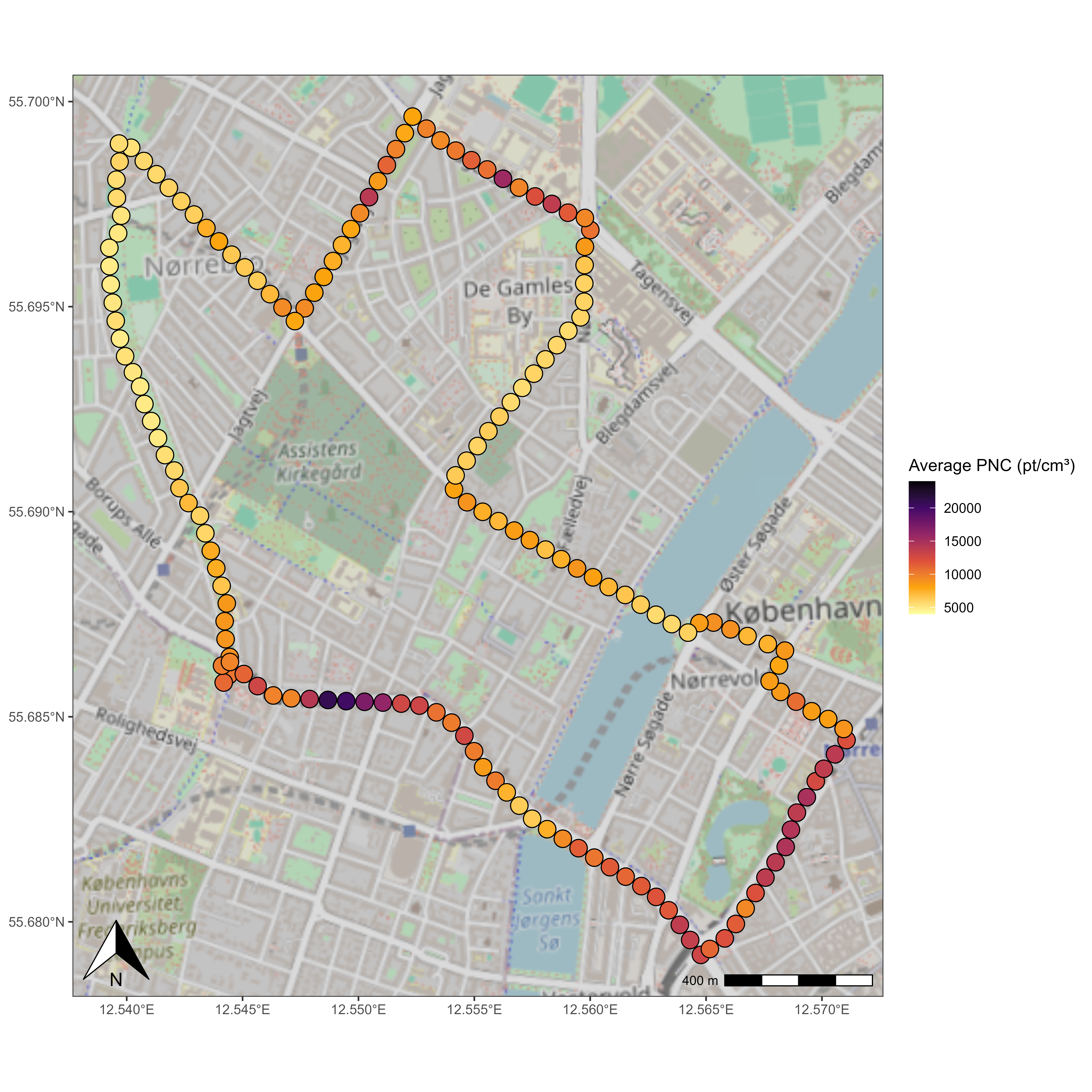
What this means for commuters
If you cycle to work, choosing a greener route with a designated cycling path, surrounded by green areas, and away from heavy motorized traffic, can lower your exposure to unhealthy environments. This take little extra travel time. Greener routes are usually also the safer and more pleasant ones.
This study didn’t investigates health effect, and long-term consequence of commuting exposure on health are still unclear.
What this means for cities
Green cycling infrastructure isn’t only good for mobility, it’s a public health intervention. By combining separation from traffic, and green space, green cycling paths protect active commuters every day. Our findings suggest that focusing on traffic reduction alone has limited benefit if cycling infrastructures stays close to traffic and UFP sources. Where cycling networks are still developing, the priority should be building new, green, separates and well-connected paths.
Data and code
This study is fully open, including code and data.
Citation
Hevia-Ramos GB, Napolitano G, Bergmann ML, Zhang J, Loft S, Andersen ZJ, Lim Y-H, Cole-Hunter T, Tuffier S. Can green cycling paths reduce commuter exposure to ultrafine particles? A repeated measures study in Copenhagen, Denmark. Sustainable Cities and Society. 2026;148:107649. doi:10.1016/j.scs.2026.107649